
Moon Tonight: Phase, Rise, Set and Position
Moon phase — Last Quarter
Illumination — 55.4%
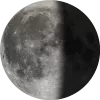
Where Is the Moon in the Sky Tonight?
Moon visibility on 2026-10-03
Moon rise and set timetable
| Time | Elevation | |
| Astronomical observing session begins | 18:15 | -20° |
Moonrise, 56.5% illuminated 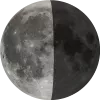 | 21:14 | 3° |
| Astronomical observing session ends | 03:38 | 76° |
| Twilight end (−12°) | 04:08 | 79° |
| Civil sunrise | 04:39 | 80° |
| Sunrise | 05:06 | 78° |
| Moon transit | 05:06 | 79° |
| Moonset | 12:53 | -8° |
Track Moon position throughout the night
← 3 October 2026 →
| Time | |
| Altitude | |
| Azimuth |
When Is the Next Full Moon?
The next Full Moon is on 25 October 2026 at 18:54. See its local time and visibility details.
Moon Phases for the Current Lunar Cycle — September 10 to October 10
| New Moon | First Quarter | Full Moon | Last Quarter | New Moon |
|---|---|---|---|---|

|

|

|

|
|
|
September 10 @ 18:10 |
September 18 @ 11:44 |
September 26 @ 07:24 |
October 3 @ 04:25 |
October 10 @ 06:23 |
| Phase | Time |
|---|---|
| New Moon | 10 September 2026 at 18:10 |
| First Quarter | 18 September 2026 at 11:44 | Full Moon | 26 September 2026 at 07:24 | Last Quarter | 3 October 2026 at 04:25 | New Moon | 10 October 2026 at 06:23 |
Want to see other Moon phases and future lunar cycles? View the Moon phases calendar.
Moon Phase on your Android home screen

Lunar Map
Moon Features Visible to the Naked Eye
Oceanus Procellarum: The largest of the lunar maria, covering a vast area on the western edge of the Moon.
Mare Imbrium: A vast lava plain resulting from a giant impact basin.
Mare Nubium: A lunar mare located in the southern part of the Moon's near side.
Clavius: One of the largest crater formations on the Moon, featuring a series of smaller craters.
Copernicus: A large crater with a well-defined, terraced rim and central peaks.
Tycho: A prominent impact crater known for its extensive ray system.
Aristarchus: A bright crater known for its high albedo and geological complexity.
Luna 2 landing site: First human-made object to reach the Moon. Impacted the lunar surface east of Mare Imbrium.
Luna 9 landing site: First successful soft landing on the Moon and transmission of photographic data back to Earth.
Apollo 12 landing site: Second manned mission to land on the Moon, with a pinpoint landing near Surveyor 3.
Apollo 14 landing site: Third manned mission to land on the Moon, focused on detailed lunar surface science.
Apollo 15 landing site: First mission to use the Lunar Roving Vehicle, allowing extensive exploration.
Discover even more lunar features with our interactive, high-resolution Moon map
Moon Passage Through the Night
Current Moon position
| Time | 17:28 |
| Latitude | 37.3541 |
| Longitude | -121.955 |
| Elevation | -24° |
| Azimuth | 12° |
Moon Dynamics This Month
| Date | Sun, 4 October 2026 |
| Twilight start | 18:13 |
| Twilight end | 03:36 |
| Rise | 22:06 |
| Set | 12:58 |
| Elevation at transit | 79° |
| Transit time | 05:32 |
| Distance to Earth | 0.00248 AU (371,003 km) |
| Equatorial coordinates at sunset | RA: 07h 13m 51s", Dec: 25° 52' 37s |
| Magnitude | -10 |
| Constellation | Gemini |
| Moon phase | Last Quarter |
| Illumination | 45.1 |
Last and Upcoming Lunar Eclipse
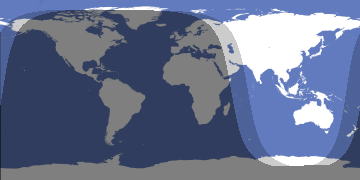
28 August 2026
Partial Lunar Eclipse
| Global | From your location | ||
|---|---|---|---|
| Penumbral | 16:26-22:02 | 17:35-22:02 | |
| Partial | 17:35-20:54 | 17:35-20:53 | |
| Total | - | - |
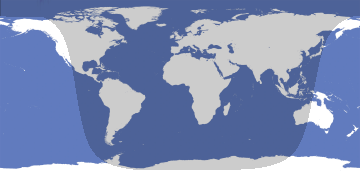
20 February 2027
Penumbral Lunar Eclipse
| Global | From your location | ||
|---|---|---|---|
| Penumbral | 12:14-16:14 | Not visible | |
| Partial | - | Not visible | |
| Total | - | Not visible |
Last and Upcoming Solar Eclipse
12 August 2026
Total Solar Eclipse
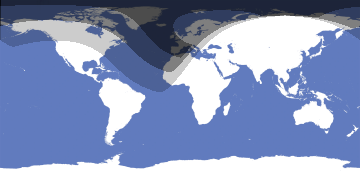
| Global | From your location | |
|---|---|---|
| Penumbra | 06:36-10:58 | Not visible |
| Umbra | 07:59-09:36 | Not visible |
6 February 2027
Annular Solar Eclipse
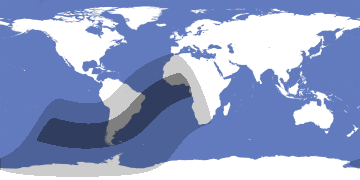
| Global | From your location | |
|---|---|---|
| Penumbra | 03:59-10:02 | Not visible |
| Antumbra | 05:05-08:57 | Not visible |
Astrometric and Physical Parameters of Moon
Coordinates and Visibility
| Right Ascension | 06h 17m 30s |
| Declination | 27° 37′ 36″ |
| Magnitude | -10.4 |
| Constellation | Gemini |
| Elevation | -24° |
| Azimuth | 12.2° |
Basic Properties
| Mass, kg | 7.349E+22 |
| Mean radius, km | 1737.4 |
| Mean density, g/cm³ | 3.3437 |
Orbit
| Orbital period, days | 27.321582 |
| Semi-major axis, km | 384400 km |
| Orbital eccentricity | 0.05490 |
| Inclination, degrees | 5.145° |
Rotation
| Mean solar day, days | 29.5306 |
Surface and Atmosphere
| Surface gravity, m/s² | 1.62 |
Brightness
| Visual magnitude V(1,0) | +0.21 |
Data Acknowledgment
Solar-system physical and orbital parameters are provided by the Solar System OpenData API maintained by Le Système Solaire. We thank its contributors for making these open data available.